Those who operate an outdoor food business know that nature doesn't respect commercial property lines. Our food truck in Brandon is anchored under a giant, old tree by the edge of a lake. It’s a visually appealing environment, but in daily practice, it is a true biological trench.
Throughout our shifts, we share the space with a constant parade of local wildlife: opportunistic raccoons, ducks, possums, feral cats, turtles, borer beetles, and some elegant, long-legged sandhill cranes that always patrol in pairs. However, our biggest operational challenge, the real war of attrition, is against the flies.
System Saturation and Failed Countermeasures
When the heat becomes suffocating or garbage collection is delayed, common flies act like a Distributed Denial of Service (DDoS) attack against the business. They harass the customers, compromise the experience, and threaten our profitability. We have tried to patch the problem with every available weapon in the arsenal: vinegar traps, bleach, aggressive insecticides, and blue light bug zappers. No countermeasure has managed to stop the plague definitively.
That is why, a few days ago, when the kitchen suddenly filled with flies, the primary instinct—and the unwritten protocol of the business—dictated immediate eradication. If you are in a constant war against a pest, you don't stop to ask questions. Unless, of course, you know how to identify the "technical specifications" of the invader.
Identifying the Modified Hardware and the 2026 Alert
At first glance, the initial panic almost made me act on instinct. But something in their behavior and appearance broke the expected physics of the common fly. They lacked that erratic, instinctive flight that frustrates anyone trying to swat them. They were exceptionally tame, clumsy, and frankly slow.
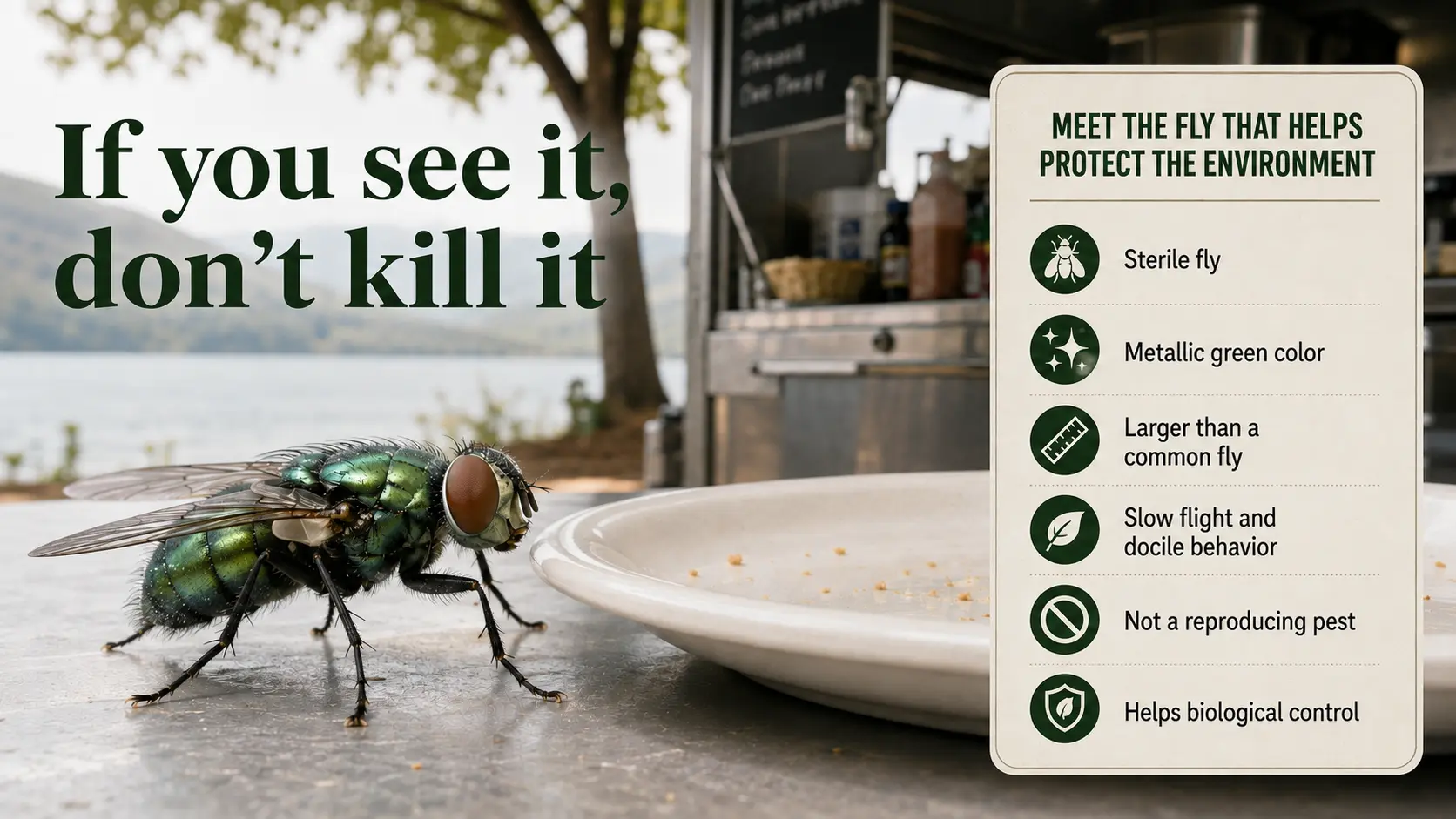
Looking closely, their distinctive features revealed that they were not the usual pest: a larger chassis and a very specific metallic green color.
Days prior, I had read an unusual warning directed at farmers and ranchers: an explicit request not to annihilate these specimens. The context is a real agricultural crisis. Since June of this year, 2026, the arrival of the devastating New World screwworm (Cochliomyia hominivorax) has put authorities on high alert. To protect Florida's cattle industry, the Department of Agriculture (USDA and FDACS) has deployed a preventative protocol in strategic areas of the state, releasing these "biological drones" produced by the Sterile Insect Technique (SIT).
They are mass-bred, exposed to radiation to alter their chromosomes, and coated with a fluorescent dye—a true "factory mark" on their hardware—so authorities can monitor their spread. Their mission is to introduce a "null code" into the wild population, causing the pest to collapse by pure statistics. That slowness I observed in the kitchen was the direct collateral damage of their manufacturing. They come from the factory without the motor optimization of natural selection; they have just enough hardware to fly, find a mate, and die.
The Clash with Material Reality
This is the point where biotechnological theory collides head-on with the pragmatism of Casa Rei. My rationality understood the purpose of the program and the immense value each of those metallic flies preventatively scattered across our county represented. But the operational reality of the grill is a closed system that admits no exceptions.
No matter how irradiated or noble its purpose, a fly in a kitchen is still a vector for cross-contamination.
The solution required a proportionate mechanical intervention. Taking advantage of that very "factory defect"—their absolute lack of evasive reflexes—I grabbed a rag and began to guide them outside. It was a careful cleanup, shooing them away one by one without killing them.
In the end, using the rag as a kinetic barrier solved the logical dilemma. The food truck's sanitary firewall remained intact, the business kept operating, and the biological control vectors were returned to the lake, free to fulfill the statistical mission for which they were assembled. Sometimes, the best way to interact with advanced technology is simply to open the door for it.